
Replies: 1 comment 1 reply

-
|
This looks like a well-thought out suggestion. Definitely merits discussion!! I'm pushed for time right now but here are some significant (in my mind) points to consider:
|
Beta Was this translation helpful? Give feedback.

-
|
These are good points to be agreed upon or if not at least capture the pro's / con's of each as part of any movement made. In particular, how best to articulate both the conceptual model as well as where they could aid information management systems. The second not being the intention of this initial effort, but could be explored if interest by anyone. Addressing each of your points in turn:
|
Beta Was this translation helpful? Give feedback.


Uh oh!
There was an error while loading. Please reload this page.
Uh oh!
There was an error while loading. Please reload this page.
-
HQDM (the book by Dr West) is extremely thorough in describing the commitments made and how he used them to produce the final data model. This data model is now what is more commonly referred to as HQDM, that is actually just the final chapter 17 of the book now captured within this repository. There is other supporting material available if you know where to look such as this summary paper on choosing a foundation data model.
Whilst EXPRESS is readable for this data model, tooling support is now limited and it would be nice to resolve some of the syntactic issues Matthew faced when documenting HQDM. For example the various permutations of underscores for particular relationships like
member_of. Human readable descriptions were also just more traditional software comments in EXPRESS and as such as not easily queryable / workable from this structure.To these points, everything that is currently captured within EXPRESS could be migrated to modern practices of semantic web to enable the wider community for getting started with HQDM. Careful consideration should be made for how best to describe the theoretical model working with and building on the serialisation effort already made and still to be finalised. The advantage being that the EXPRESS can be kept as original source material but depreciated without loss of understanding about the data model.
Proposal
The HQDM ontology should use RDF(S) with supporting shape constraints (SHACL) to completely describe the intention of the model. To do this it seems common practice to have 2 main files*:
1. A main definition file capturing:
foaf:Imagefor where image diagrams exist orskos:examplefor where examples are already on the wiki.2. A supporting shape constraint (SHACL) file to:
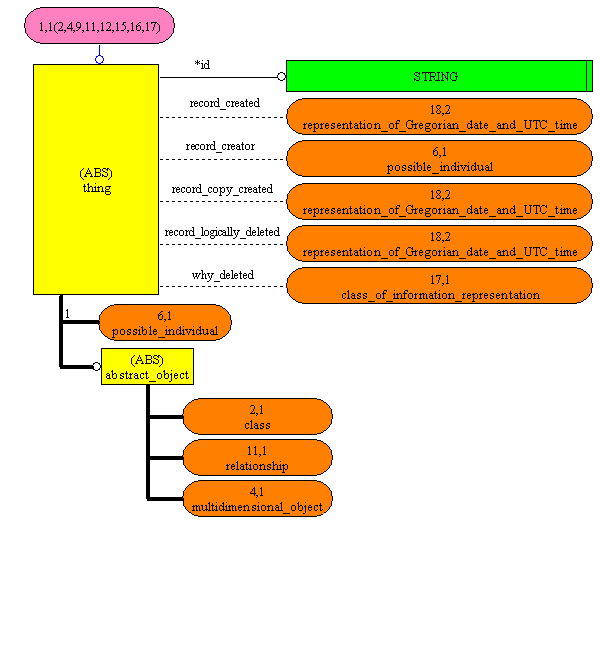
abstract_objectcan only be aclassor arelationshipas captured on this diagram / EXPRESS ONEOF.associationcan have any number ofparticipants, howeveremploymentcan only have 2; 1 employer and 1 employee.There will be other aspects that could or should be included not yet captured, however as foundation I believe these aspects cover the vast majority of current common practice that HQDM could utilise. The current information in the wiki is all captured above, including the inheritance graph should be possible to be automatically calculated / extractable from the ontology but is naturally the most difficult.
Annex
* 2 main files - Other permutations include 1) the SHACL definitions combined with the main definitions, which whilst correct to the specification, tooling such as pySHACL currently struggles with at the time of writing. Or 2) splitting out the documentation (rdfs:Label and rdfs:Comment) away from the main definition file creating 3 files overall, which again whilst also valid tooling has been known to struggle with only accepting one definition file with docs expected. The above breakdown is seen as the best route forward.
Beta Was this translation helpful? Give feedback.
All reactions