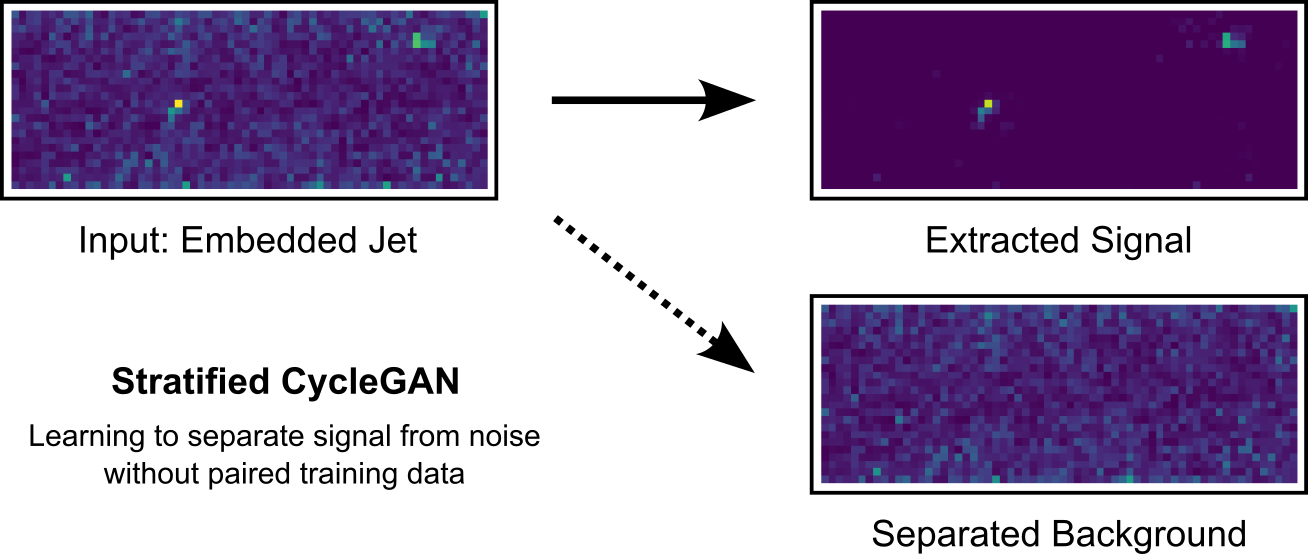
This repository provides a reference implementation of Stratified CycleGAN (UVCGAN-S), an architecture for unsupervised signal extraction from mixed data.
What problem does Stratified CycleGAN solve?
Suppose you have three datasets. The first contains clean signals. The second contains backgrounds. The third contains mixed data where signals and backgrounds have been combined in some complicated way. You don't know exactly how the mixing happens, and you can't find pairs that show which clean signal corresponds to which mixed observation. But you need to take new mixed data and decompose it back into signal and background components.
Stratified CycleGAN learns to do this decomposition from unpaired examples. You show it random samples of signals, random samples of backgrounds and mixed data, and it figures out both how to combine signals and backgrounds into realistic mixed data, and how to decompose mixed data back into its parts.
See the Quick Start section for a concrete example using cat and dog images.
The package was tested only under Linux systems.
Development environment based on
pytorch/pytorch:1.12.1-cuda11.3-cudnn8-runtime container.
There are several ways to setup the package environment:
Option 1: Docker
Download the docker container pytorch/pytorch:1.12.1-cuda11.3-cudnn8-runtime.
Inside the container, create a virtual environment to avoid package conflicts:
python3 -m venv --system-site-packages ~/.venv/uvcgan-s
source ~/.venv/uvcgan-s/bin/activate
Option 2: Conda
conda env create -f contrib/conda_env.yaml
conda activate uvcgan-sOnce the environment is set, install the uvcgan-s package and its
requirements:
pip install -r requirements.txt
pip install -e .By default, UVCGAN-S reads datasets from ./data and saves models to
./outdir. If any other location is desired, these defaults can be overriden
with:
export UVCGAN_S_DATA=/path/to/datasets
export UVCGAN_S_OUTDIR=/path/to/modelsThis package was developed for sPHENIX jet signal extraction. However, jet signal analysis requires familiarity with sPHENIX-specific reconstruction algorithms and jet quality analysis procedures. This section demonstrates application of Stratified CycleGAN method on a simpler toy problem with intuitive interpretation. The toy example illustrates the basic workflow and serves as a template for applying the method to your own data.
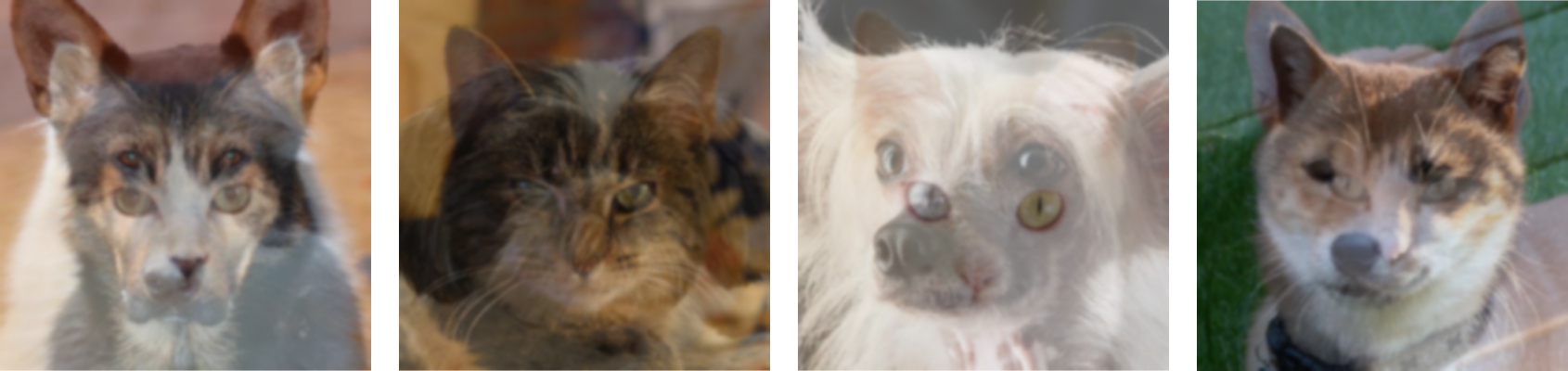
The toy problem is this: we have images that contain a blurry mix of cat and dog faces. The goal is to automatically decompose these mixed images into separate cat and dog images. To this end, we present Stratified CycleGAN with the mixed images, a random sample of cat images, and a random sample of dog images. By observing these three collections, the model learns how cats look on average, how dogs look on average, and what would be the best way to decompose the current mixed image into a cat and a dog. Importantly, the model is never shown training pairs like "this specific mixed image was created from this specific cat image and this specific dog image." It only sees random examples from each collection and figures out the decomposition on its own.
Before proceeding further, the package needs to be installed following instructions at the top of this README, if not installed already.
The toy example uses cat and dog images from the AFHQ dataset. To download and preprocess it:
# Download the AFHQ dataset
./scripts/download_dataset.sh afhq

# Resize all images to 256x256 pixels
python3 scripts/downsize_right.py -s 256 256 -i lanczos \
    "${UVCGAN_S_DATA:-./data}/afhq/" \
    "${UVCGAN_S_DATA:-./data}/afhq_resized_lanczos"
The resizing script creates a new directory afhq_resized_lanczos containing
256x256 versions of all images, which is the format expected by the training
script.
To train the model, run the following command:
python3 scripts/train/toy_mix_blur/train_uvcgan-s.pyThe script trains the Stratified CycleGAN model for 100 epochs. On an RTX 3090
GPU, each epoch takes approximately 3 minutes, so the complete training process
requires about 5 hours. The trained model and intermediate checkpoints are
saved in the directory
${UVCGAN_S_OUTDIR:-./outdir}/toy_mix_blur/uvcgan-s/model_m(uvcgan-s)_d(n_layers)_g(vit-modnet)_cat_dog_sub/.
The structure of the model directory is described in the F.A.Q..
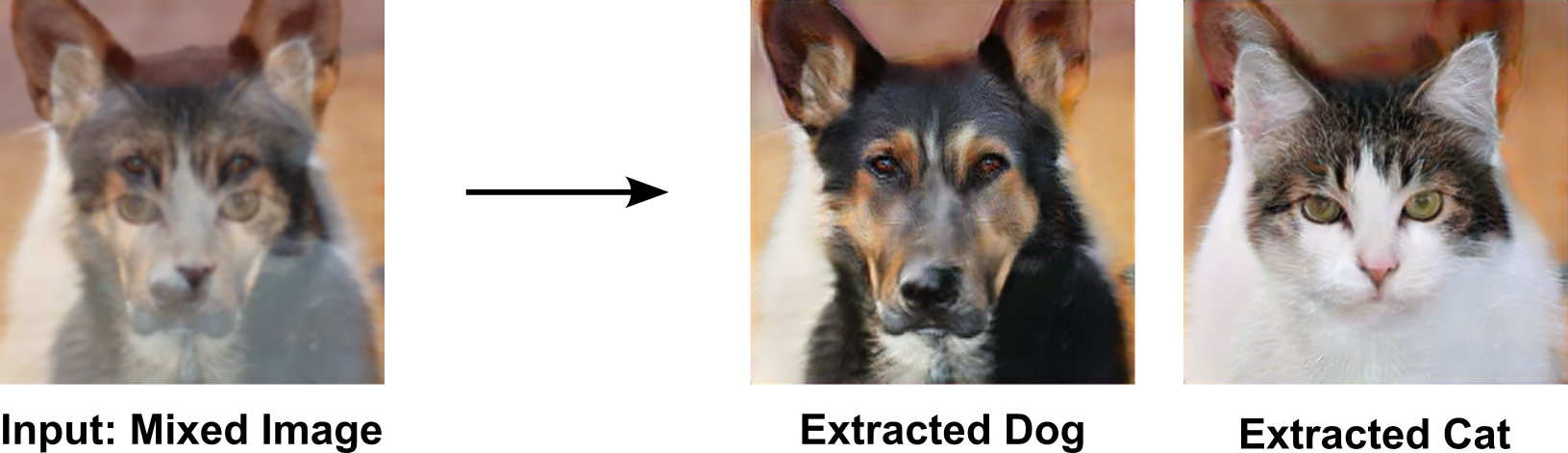
After training completes, the model can be used to decompose images from the validation set of AFHQ. Run:
python3 scripts/translate_images.py \
    "${UVCGAN_S_OUTDIR:-./outdir}/toy_mix_blur/uvcgan-s/cat_dog_sub" \
    --split val \
    --domain 2 \
    --format image
This command takes the mixture cat-dog images (Domain B) and decomposes them
into separate cat and dog components (Domain A). The --domain 2 flag
specifies that the input images come from Domain B, which contains the mixed
data.
The results are saved in the model directory under
evals/final/translated(None)_domain(2)_eval-val/. This evaluation directory
contains several subdirectories:
fake_a0/- extracted cat componentsfake_a1/- extracted dog componentsreal_b/- original blurred mixture inputs
Each subdirectory contains numbered image files (sample_0.png,
sample_1.png, etc.) corresponding to the validation set.
To apply Stratified CycleGAN to a different decomposition problem, use the toy
example training script as a starting point. The script
scripts/train/toy_mix_blur/train_uvcgan-s.py contains a declarative
configuration showing how to structure the three required datasets and set up
the domain structure for decomposition. For a more complex example, see
scripts/train/sphenix/train_uvcgan-s.py.
The package was developed for extracting particle jets from heavy-ion collision backgrounds in sPHENIX calorimeter data. This section describes how to reproduce the paper results.
The sPHENIX dataset can be downloaded from Zenodo: https://zenodo.org/records/17783990
Alternatively, use the download script:
./scripts/download_dataset.sh sphenixThe dataset contains HDF5 files with calorimeter energy measurements organized as 24×64 eta-phi grids. The data is split into training, validation, and test sets. Training data consists of three components: PYTHIA jets (the signal component), HIJING minimum-bias events (the background component), and embedded PYTHIA+HIJING events (the mixed data). The test set uses JEWEL jets embedded in HIJING backgrounds. JEWEL models jet-medium interactions differently from PYTHIA, providing an out-of-distribution test of the model's generalization capability.
There are two options for obtaining a trained model: training from scratch or downloading the pre-trained model from the paper.
To train a new model from scratch:
python3 scripts/train/sphenix/train_uvcgan-s.pyThe training configuration uses the same Stratified CycleGAN architecture as
the toy example, adapted for single-channel calorimeter data. The trained model
is saved in the directory
${UVCGAN_S_OUTDIR:-./outdir}/sphenix/uvcgan-s/model_m(uvcgan-s)_d(resnet)_g(vit-modnet)_sgn_bkg_sub
(see F.A.Q. for details on the
model directory structure).
Alternatively, a pre-trained model can be downloaded from Zenodo: https://zenodo.org/records/17809156
The pre-trained model can be used directly for evaluation without retraining.
To evaluate the model on the test set:
python3 scripts/translate_images.py \
    "${UVCGAN_S_OUTDIR:-./outdir}/path/to/sphenix/model" \
    --split test \
    --domain 2 \
    --format ndarray
The --format ndarray flag saves results as NumPy arrays rather than images.
The output structure is similar to the toy example: extracted signal and
background components are saved in separate directories under evals/final/.
Each output file contains a 24×64 calorimeter energy grid that can be used for
physics analysis.
You can specify GPUs that pytorch will use with the help of the
CUDA_VISIBLE_DEVICES environment variable. This variable can be set to a list
of comma-separated GPU indices. When it is set, pytorch will only use GPUs
whose IDs are in the CUDA_VISIBLE_DEVICES.
uvcgan-s saves each model in a separate directory that contains:
MODEL/config.json-- model architecture, training, and evaluation configurationsMODEL/net_*.pth-- PyTorch weights of model networksMODEL/opt_*.pth-- PyTorch weights of training optimizersMODEL/shed_*.pth-- PyTorch weights of training schedulersMODEL/checkpoints/-- training checkpointsMODEL/evals/-- evaluation results
uvcgan-s enforces a one-model-per-directory policy to prevent accidental
overwrites of existing models. Each model directory must have a unique
configuration - if you try to place a model with different settings in a
directory that already contains a model, you'll receive a "Config collision
detected" error.
This safeguard helps prevent situations where you might accidentally lose trained models by starting a new training run with different parameters in the same directory.
Solutions:
- To overwrite the old model: delete the old
config.jsonconfiguration file and restart the training process. - To preserve the old model: modify the training script of the new model and
update the
labeloroutdirconfiguration options to avoid collisions.
uvcgan-s is distributed under BSD-2 license.
uvcgan-s repository contains some code (primarily in uvcgan_s/base
subdirectory) from pytorch-CycleGAN-and-pix2pix.
This code is also licensed under BSD-2 license (please refer to
uvcgan_s/base/LICENSE for details).
Each code snippet that was taken from pytorch-CycleGAN-and-pix2pix has a note about proper copyright attribution.