foambryo is a python package developed to infer relative surface tensions and cell pressures from the 3D geometry of cells in foam-like clusters, such as early-embryos, tissues or organoids.
It was developed by Sacha Ichbiah during his PhD in Turlier Lab, and is maintained by Matthieu Perez and Hervé Turlier. For support, please open an issue. If you use our library in your work please cite the article: Ichbiah S., Delbary F., McDougall A., Dumollard R., Turlier H. Embryo mechanics cartography: inference of 3D force atlases from fluorescence microscopy. Nature Methods 20(12), 1989–1999 (2023).
If you are interested in inferring tensions in 2D, please look at the foambryo2D package instead.
0.5.0 is the first release on PyPI since 0.3.5. In short (the full list is in the CHANGELOG, and what can mislead you is in the release notes):
- Meshes reconstructed from a mask are different: delaunay-watershed 0.5.0 moves every mesh's
trijunction vertices onto the junction curves the mask gives, and
dcel_mesh_from_segmentation_masknow usesmin_distance=3(was 5). Inferred angles, tensions and pressures move accordingly. - Several methods now give correct results where earlier versions gave wrong or missing ones:
Equilibriumno longer crashes,Cotan/InvCotanlost an operator-precedence bug, meshes with a disconnected junction graph are solved per component, and the pressure functions raiseUndeterminedTensionErrorinstead of returning non-finite values. - New, opt-in: a second-order angle reading (
angle_reading="quadric", below), arefusalkeyword to decline folded trijunction observations, uncertainty intervals (infer_tensions_with_uncertainty) and identifiability diagnostics (compute_inference_diagnostics). torchis no longer installed by default (pip install "foambryo[autodiff]"if you need it).- New licence, GPL-3.0 (see License), and Python 3.11 or later is required.
Multicellular structures encountered in the field of developmental biology have various shapes and arrangements that reflect their physiological functions. Mechanics is at the heart of the development of these structures, yet tools to investigate the forces at play in 3D remain scarce. Inferring forces or stresses from cell shapes only allows one to reveal the fundamental mechanics shaping cells from microscopy imaging. This software makes the hypothesis that cells in many early embryos, tissues and cell aggregates are mechanically akin to heterogeneous foam-like structures (see Physical model).
foambryo requires Python 3.11 or later, with pip.
foambryo requires the prior segmentation of images of multicellular aggregates into cell segmentation masks using one's favorite algorithm (watershed algorithm, cellpose or any preferred one). The quality of the segmentation and the size of the original image will directly affect the precision of the inference results.
All required dependencies are installed by pip automatically.
foambryo relies on a companion tool delaunay-watershed that we developed to construct precise multimaterial meshes from instance segmentations. From these multimaterial meshes, one can efficiently and robustly measure junction angles and interface curvatures to invert the Young-Dupré and Laplace laws and infer the surface tensions
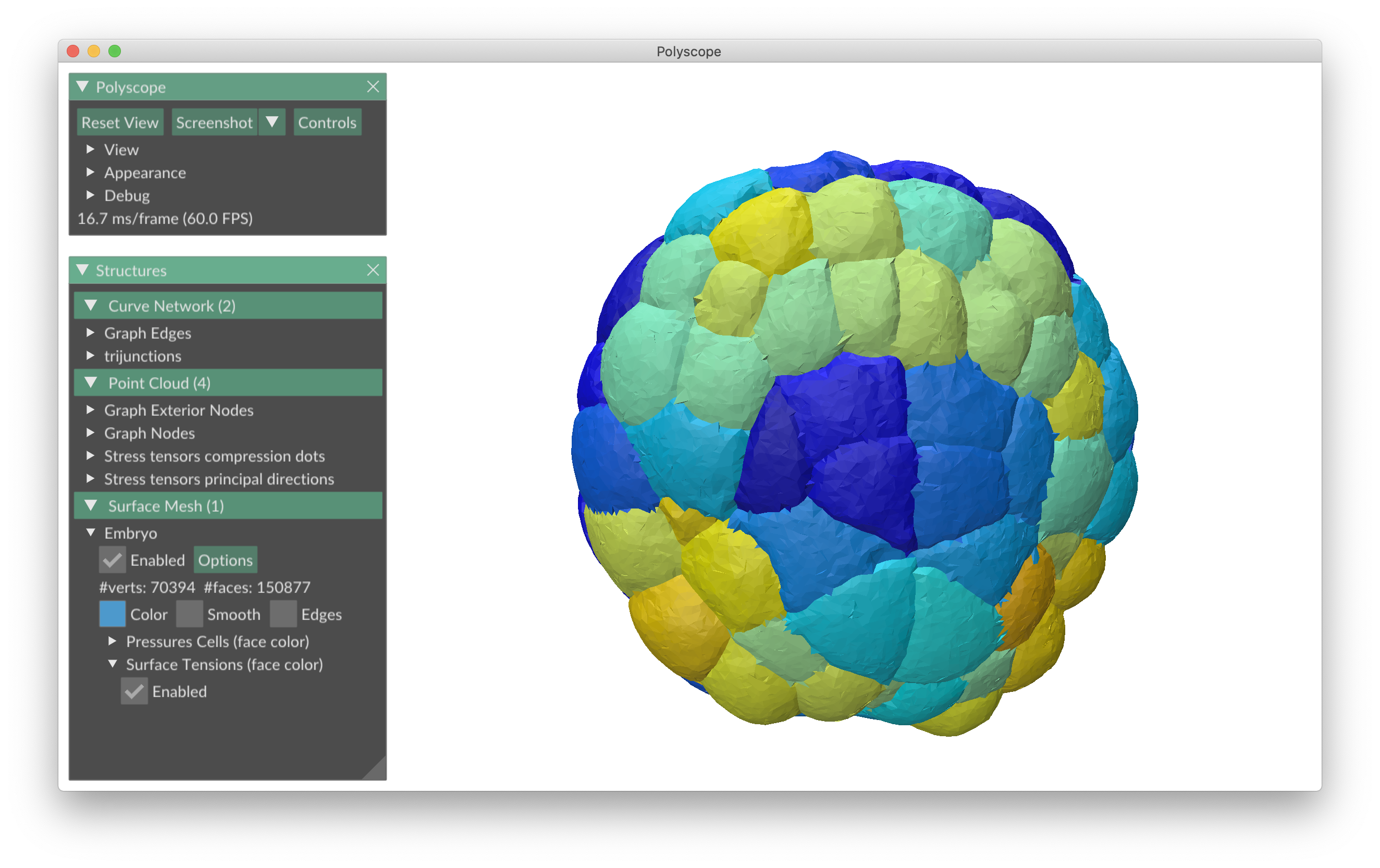
The viewer is based on Polyscope, a C++/Python viewer designed to visualize 3-dimensional geometry, in particular meshes.
Tested for 0.5.0 on macOS 14.8.4 on Apple silicon (arm64), with Python 3.12. Other operating systems, and the other supported Python versions (3.11 or later), are expected to work but were not tested for this release.
We recommend to install foambryo from the PyPI repository directly.
pip install foambryoTo use the foambryo viewers, use instead:
pip install "foambryo[viewing]"For developers, you may also install foambryo by cloning the source code and installing from the local directory.
git clone https://github.com/VirtualEmbryo/foambryo.git
pip install ./foambryoLoad an instance segmentation, reconstruct its multimaterial mesh, infer and visualize the forces with Polyscope
from foambryo import dcel_mesh_from_segmentation_mask
from foambryo.viewing import plot_force_inference, plot_tension_inference

# Load the labels
import skimage.io as io
segmentation_mask = io.imread("Segmentation.tif")

# Reconstruct a multimaterial mesh from segmentation
mesh = dcel_mesh_from_segmentation_mask(segmentation_mask)  # DCEL mesh ready for force inference !

# Infer and view the forces
plot_force_inference(mesh)

#Or just the tensions
plot_tension_inference(mesh)
See the introductory notebook for further details.
We consider a tissue constituted of cells i.
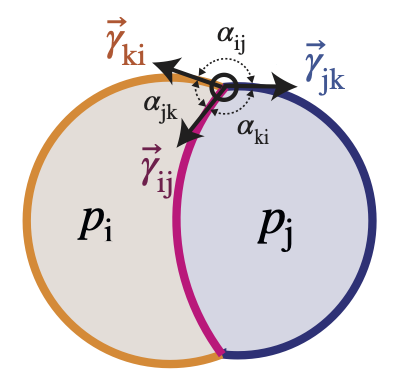
They minimize, under conservation of volume, an energy
The two main laws underlying mechanical force balance are:
-
Young-Dupré Law:
$\gamma_{ij}\vec t_{ij} + \gamma_{ik}\vec t_{ik} + \gamma_{jk}\vec t_{jk} = \vec 0$ at each junction line between the cells i, j and k, where$\vec t_{ij}$ is the unit vector tangent to the interface between the cells i and j, normal to the junction line and pointing away from it. -
Laplace Law:
$p_j - p_i = 2 \gamma_{ij} H_{ij}$ where$H_{ij}$ is the mean curvature of the interface between the cell i and j.
See the introductory notebook to understand the API.
The notebook shows how to create a mesh and how foambryo compute forces on the mesh.
We recall that the forces are relative, this is why you need to give the mean tension and base pressure.
base_pressure: reference exterior pressure. All pressures inside cells are computed relative to this one.mean_tension: as one only infers ratios between tensions, it has to be given. You can set it to 1 for instance.
Foambryo has several strategies to compute tensions. They fall into two families that respond
very differently to mesh-reconstruction quality — see BENCHMARKS.md — angle-reading methods,
which read local contact angles at triple junctions, and operator-inverting methods, which
assemble and invert a global discrete operator over the whole mesh:
Angle-reading:
YoungDupre(Young-Dupré with cosines only) — the recommended default when mesh quality is uncertain,YoungDupreLocal(the same balance imposed per trijunctional edge instead of once per triple line; a better diagnostic, a worse point estimate),ProjectionYoungDupre(Young-Dupré with cosines and sines),Lami(Lami's theorem),InvLami(inverse of the Lami's relation),LogLami(logarithm of the Lami's relation).
Operator-inverting:
Cotan(cotangent formula, see Yamamoto et al. 2026),InvCotan(inverse of the cotangent formula),Variational(variational formulation, see our article),ForceBalance,ForceBalanceSoftRow,ForceBalanceMAP(the unified discrete force-balance operator under three different gauge treatments — hard KKT, soft least-squares row, and a Gaussian-prior MAP estimate with uncertainty).
Also: Equilibrium, a geometric-edge balance that fits neither family cleanly.
Every method above that reads angles — the six angle-reading ones plus Cotan and InvCotan —
takes an angle_reading keyword. It selects how a contact angle is measured on the mesh, not
how tensions are solved for once it has been measured:
angle_reading="chord"(the default, and unchanged) measures the angle between the two incident triangles' flat faces. A flat triangle has no curvature to report, so on a curved interface it reports the angle of the chord to the triangle's far vertex rather than the interface's tangent at the junction.angle_reading="quadric"fits a generic quadric surface to the interface's own mesh vertices in a small window around each junction edge and reads that surface's tangent instead. For a circular arc the two differ by exactlyκL/2, withκthe interface's curvature andLthe distance to the triangle's far vertex, and that is the correction applied.- Nothing else changes: no vertex moves, no interface area or cell volume changes, and the mesh is untouched. Only the angle is read differently.
from foambryo import TensionComputationMethod, dcel_mesh_from_file, infer_tensions

mesh = dcel_mesh_from_file("my_mesh.rec")
tensions = infer_tensions(mesh, 1, TensionComputationMethod.YoungDupre, angle_reading="quadric")
The measured gain, on 42 mechanically-equilibrated benchmark cases meshed by dw3d (see
BENCHMARKS.md for the full table and its provenance):
dw3d min_distance |
3 | 4 |
|---|---|---|
length-weighted junction-angle flattening slope, chord |
−0.2343 | −0.2204 |
the same, quadric |
−0.0848 | −0.0170 |
tension contrast (1.000 is perfect), chord |
0.738 | 0.722 |
the same, quadric |
0.954 | 1.056 |
median per-line angle error, chord |
7.35° | 8.22° |
the same, quadric |
4.83° | 5.43° |
Contrast and per-line angle error improve together, which is what distinguishes a geometry fix from a bias-for-variance trade.
The window is fixed and is not a tuning parameter. The quadric is fitted in a window of four times the triangle's own lever, isotropic in the two surface directions. Those values were chosen a priori and then re-selected independently by held-out fit residual under a pre-registered coverage floor, which landed back on exactly them. They are module constants rather than arguments on purpose: exposing them would invite tuning them against the very error they are judged on, and a window tuned that way would flatter itself.
Coverage, and what happens where the fit does not apply. The quadric needs at least ten of the interface's own mesh vertices inside its window. Where it has fewer, that face keeps the chord reading, and a result can therefore mix the two conventions. This is never silent:
from foambryo import infer_tensions_and_residuals_with_report

*_values, report = infer_tensions_and_residuals_with_report(
    mesh, 1, TensionComputationMethod.YoungDupre, angle_reading="quadric",
)
report.coverage_fraction    # e.g. 0.919 -- the fraction of trijunction faces corrected
report.uncorrected_lines    # the trijunction lines that are only partly corrected
report.is_complete          # False when any face fell back
Calling infer_tensions or compute_angles_tri directly, which drop the report, emits an
AngleReadingCoverageWarning carrying the same numbers instead. On the benchmark meshes coverage
is 0.919 of faces at min_distance = 3 and 0.890 at 4 — but only 0.220 and 0.178 of
lines are corrected throughout, so most lines carry a mixture. Look at uncorrected_lines, not
only at the fraction.
When not to use it, and this is the most important caveat. The correction removes a
κL/2 chord deficit, and on a well-resolved mesh that deficit is already small while the
reader's known over-application is not. Measured on the 47 ground-truth simulation meshes that
ship with the benchmark — far finer than any reconstruction — the chord reading's contrast is
already 1.000 to within 2×10⁻⁵, and angle_reading="quadric" moves it to a median of 1.080,
worse on 47 of 47 cases. Use it on dw3d-reconstructed meshes, not on simulator output or
any mesh whose elements are already much smaller than the interface's radius of curvature.
The honest residual. The correction is not exact, and four measured facts qualify it:
- It over-applies at fine spacing. On a coarsened reference mesh, where the true angles are
known, the reader removes about 26 % more rotation than the chord deficit it exists to remove
at
min_distance = 3; bymin_distance = 7it under-applies instead. The reference-mesh result above is the same effect at its most extreme. - Consequently a residual slope survives: the corrected arm sits +0.0487 above its own
corrected floor at
min_distance = 3, while atmin_distance = 4the excess contains zero (−0.0102, CI [−0.0288, +0.0127]). YoungDupreLocalis the one method whose tension error gets worse under the quadric reading even though its angles improve — it imposes the balance per edge and so never performs the along-line average that cancels the correction's per-edge scatter. UseYoungDuprewithangle_reading="quadric", notYoungDupreLocal.- It reads angles a second-order surface fit reports; it does not move any vertex, so it cannot repair a mesh whose junction line is in the wrong place.
A runnable side-by-side comparison on one benchmark case:
Examples/second_order_angle_reading.py.
A folded trijunction edge is one whose three interior wedge angles do not enclose the edge the
way a trijunction requires: one of them is past a straight angle. The Young-Dupré balance every
angle-reading method above imposes presupposes the opposite, so such a row is an observation the
geometry rules out. On dw3d-reconstructed meshes 2-25 % of trijunctional edges are folded,
depending on the point placement; on the simulator's own meshes essentially none are (5 in 14 183).
Two reasons this cannot be read away. YoungDupreLocal's rows are built from cos of the wedge,
and cos is even about a full turn, so a folded wedge and its reflection are literally the same
row — no angle_reading reaches it. And LogLami's rows take log(sin(...)), which is undefined
for a folded wedge, so it does not degrade there, it raises.
infer_tensions and its relatives therefore take a refusal keyword, which is off by default
and changes nothing until you pass it:
from foambryo import (
    TensionComputationMethod, WedgeRefusal, WedgeRefusalPolicy,
    dcel_mesh_from_file, infer_tensions, reflex_trijunction_edges, refusal_report,
)

mesh = dcel_mesh_from_file("my_mesh.rec")
len(reflex_trijunction_edges(mesh))          # how many edges of this mesh are folded

refusal = WedgeRefusal(policy=WedgeRefusalPolicy.ExcludeEdgeFromLineMean)
tensions = infer_tensions(
    mesh, 1, TensionComputationMethod.YoungDupre, angle_reading="oriented_chord", refusal=refusal,
)
refusal_report(mesh, refusal)                # what was declined, in rows and in arclength
The three policies differ in what they do with a line that is only partly folded:
ExcludeEdgeFromLineMean— the folded edge leaves its line's angle mean and its line's length; the line still reports, from what survives.DropLine— a line carrying any folded edge does not report at all.DownweightLine— nothing is removed from the measurement; the line's mean is unchanged and only its row weight is scaled, by the fraction of its arclength that is not folded.
Report the refused share alongside any accuracy you gain from this. A policy that improves an
error statistic by declining the data it would have got wrong has not improved anything, and
refusal_report is what makes that visible. Measured on 15 reconstruction variants x 40
mechanically-equilibrated benchmark cases: ExcludeEdgeFromLineMean lowers the gauge-matched
tension error on all 15 and on all eight angle-reading methods, and leaves every interface
determined; DropLine costs a median 16-76 % of the junction lines, which is nothing to
YoungDupreLocal (whose row is one edge) and is most of the data to every line-averaged method,
on some meshes all of it.
What happens when a refusal leaves something unconstrained. An interface with no surviving
junction line is reported float("nan"), never a number, with the same
JunctionGraphGaugeWarning a fully closed interface already raises; a mesh with no surviving
observation at all returns nan for every interface rather than raising. Use
infer_tensions_by_junction_component to see which interfaces those are and which gauge component
each surviving one belongs to.
A method that reads no wedge angle refuses a policy rather than ignoring it — Equilibrium,
Variational and the three ForceBalance* members raise, for the same reason they already refuse
a non-default angle_reading.
A runnable comparison of the three policies on one benchmark case:
Examples/refusing_folded_trijunction_wedges.py.
And also to compute pressures:
Variational(variational formulation, see our article),Laplace(Laplace's law)WeightedLaplace(Laplace's law with weight on curvature by area).
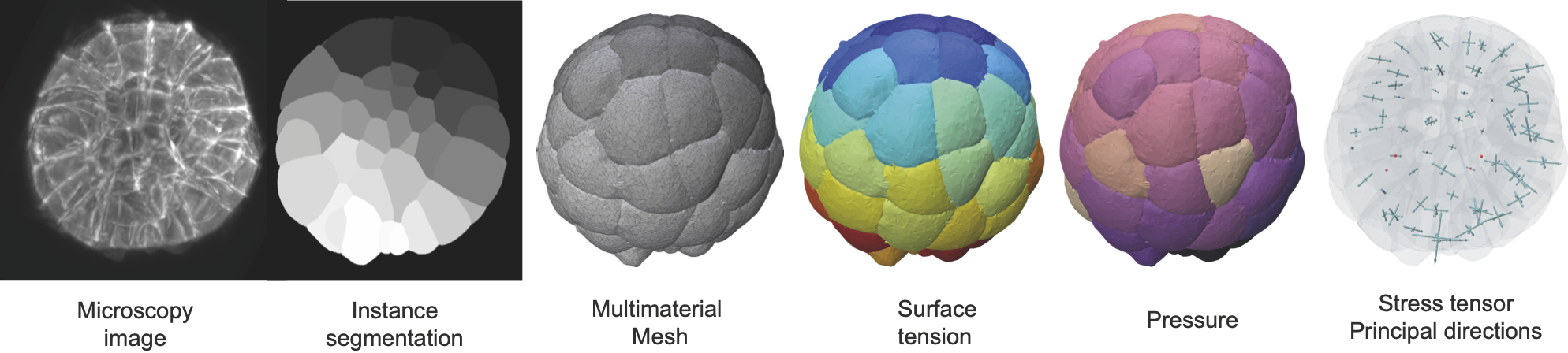
Phallusia mammillata is a solitary marine tunicate of the ascidian class known for its stereotypical development. As the embryo develops freely, without any constraint, we can do a full force inference and infer its tensions, pressures and stresses. We use segmentation data from Guignard, L., Fiúza, U. et al.
Caenorhabditis elegans is a widely studied model organism, with one of the most reproducible development. The embryo of this earthworm is developing within a shell. As the shell shape and mechanics is unknown, the pressures are not accessible. However we can still use Young-Dupré relationships to retrieve surface tensions at cell membranes. Here we use segmentation data from Cao, J., Guan, G., Ho, V.W.S. et al.

Gaussian and mean curvatures can be plotted on our meshes, and may be useful to study the geometric properties of interfaces between cells.
We can also plot the vertex area and volume derivatives, that appear in our variational formulas, the difference between the two principal curvatures and the residual of the best sphere-fit that can be used to detect non-spherical constant-mean-curvature surfaces.
They can be obtained by putting the option scalar_quantities = True when viewing the forces.
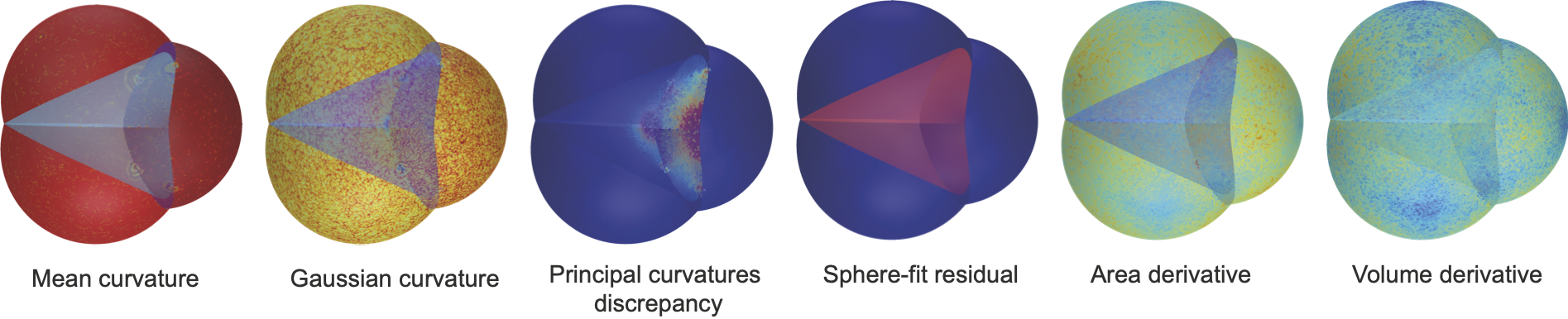
- Gaussian Curvature is computed using the angle defect formula.
- Mean Curvature is computed using the cotan formula.
The notebooks in the Examples folder show how to run the inference and the viewers.
The project's development record (working notes, exploratory scripts and their results) is
kept in the development repository for provenance and is not part of the distribution:
pip install does not ship it, and nothing under foambryo imports from it.
If you use this tool, please cite the associated article: Ichbiah S., Delbary F., McDougall A., Dumollard R., Turlier H. Embryo mechanics cartography: inference of 3D force atlases from fluorescence microscopy. Nature Methods 20(12), 1989–1999 (2023), doi:10.1038/s41592-023-02084-7. Do not hesitate to contact Matthieu Perez and Hervé Turlier for practical questions and applications. We hope that foambryo could help biologists and physicists to shed light on the mechanical aspects of early development.
@article{Ichbiah2023,
  author    = {Ichbiah, Sacha and Delbary, Fabrice and McDougall, Alex and Dumollard, R{\'e}mi and Turlier, Herv{\'e}},
  title     = {Embryo mechanics cartography: inference of {3D} force atlases from fluorescence microscopy},
  journal   = {Nature Methods},
  volume    = {20},
  number    = {12},
  pages     = {1989--1999},
  year      = {2023},
  month     = dec,
  publisher = {Springer Science and Business Media LLC},
  issn      = {1548-7105},
  doi       = {10.1038/s41592-023-02084-7},
  url       = {https://doi.org/10.1038/s41592-023-02084-7}
}From version 0.5.0 this work is licensed under the GNU General Public License, version 3
of the License, or (at your option) any later version (SPDX GPL-3.0-or-later); the text of
version 3 is in License.
Earlier releases keep the licence they were published under (CC BY-NC-SA 4.0).