Fast, accurate continuous-beam analysis for the design, assessment and teaching of buildings and bridges —
from linear statics to plastic collapse, modal dynamics and moving-load bridge assessment.







PyCBA is a focused, dependable 1-D continuous-beam engine built on the matrix (direct)
stiffness method. It is deliberately not a general 2-D/3-D FE package — instead it does one
thing extremely well, with a clean API, light dependencies (numpy / scipy / matplotlib),
and an analysis core that powers a surprisingly broad toolkit.
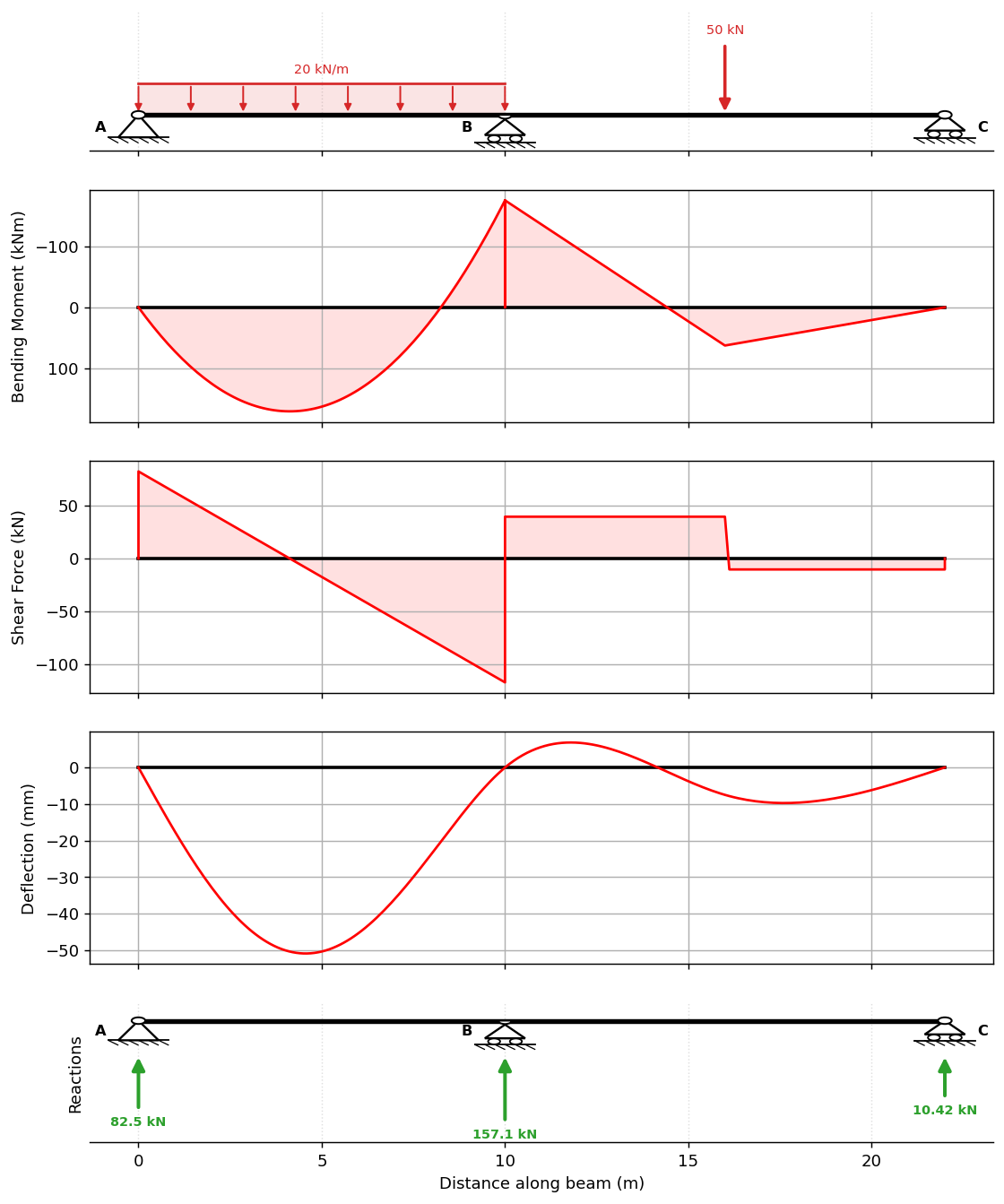
import pycba as cba

# A two-span continuous beam: 10 m + 12 m, EI = 30 000 kN·m², pinned supports
beam = cba.BeamAnalysis(L=[10, 12], EI=30_000, supports=["pin", "pin", "pin"])
beam.add_udl(i_member=1, w=20)         # 20 kN/m on span 1
beam.add_pl(i_member=2, p=50, a=6)     # 50 kN point load at mid-span 2
beam.analyze()

beam.plot_results()                    # bending moment, shear, deflection + reactions
print(beam.at(5.0)) # -> {'M': 162.5, 'V': -17.5, 'R': 0.0, 'D': -0.05}Analysis
- Continuous beams of any number of spans, with pin / roller / fixed / vertical-spring / rotational-spring supports, prescribed settlements, and internal hinges — plus pre-solve mechanism detection.
- An element library: Euler–Bernoulli, Timoshenko (shear-deformable), non-prismatic (variable
EI), and beam-on-Winkler-foundation. - Nonlinear elasto-plastic analysis to collapse (plastic hinges, mechanism detection, collapse-mechanism plots).
- Free-vibration (modal) analysis — natural frequencies, periods and mode shapes.
Loads & bridges
- UDL, point, partial, trapezoidal, moment and imposed-curvature (creep / shrinkage / thermal) loads; load cases, combinations and patterned UDLs.
- Moving-load bridge assessment — influence lines, envelopes, coincident effects, lane UDLs and shear points / critical shear.
- Code load models — road & rail, from six nations — AASHTO HL-93, Eurocode LM1 / LM71, BS 5400 / CS 454 HB, CSA CL-625, China JTG, AREA Cooper E, AS 5100 M1600 / S1600 / 300LA, NAASRA T44 / MS18 — organised by region.
- A post-tensioning preprocessor for prestress.
Visualisation
- Beam & load schematics in matplotlib and publication-quality TikZ /
stanli. - Shaded bending-moment / shear / deflection diagrams, reaction plots, coincident-effects, mode-shape, collapse-mechanism and vehicle plots.
- An interactive Plotly backend, and selectable display unit systems (SI / US / N·mm).
Ergonomics
- Point queries
at(x), exportsto_dataframe()/to_csv(), a friendlysupports=API, and clear errors — all validated against closed-form solutions, with 370+ tests.
pip install pycba                 # core
pip install "pycba[plotly]"       # + interactive plots
Requires Python 3.9+.
Full documentation, a Theoretical Basis, and a dozen worked-example notebooks (bridges, foundations, modal, non-prismatic, nonlinear collapse, creep/shrinkage/thermal, the vehicle library, and more) are at ccaprani.github.io/pycba.
PyCBA began life as a Python port of Colin Caprani's MATLAB
Continuous Beam Analysis program (later
ported to C++ by Pierrot). It has since grown well beyond that
starting point into the toolkit above — but the spirit is unchanged: fast, exact, and a pleasure to use.
PyCBA is released under the GNU Affero General Public License v3.0 (AGPL-3.0). In short:
you are free to use PyCBA for any purpose — including professional and commercial work — but
if you incorporate it into your own software, or offer it over a network (e.g. a hosted
or SaaS tool), that software must in turn be released under the AGPL. Contributions and issues
are welcome on GitHub.