





Converts a given crate and version number to a BibLaTeX entry.
The crate will try to determine if a publication is already available by scanning for possible
CITATION.cff files.
It will further generate entries from the information available at crates.io.
There are 4 distinct ways of using this package:
- Webapp jonaspleyer/.github.io/crate2bib
- Python bindings pypi.org/project/crate2bib
- CLI tool crate2bib-cli
- Rust crate crate2bib
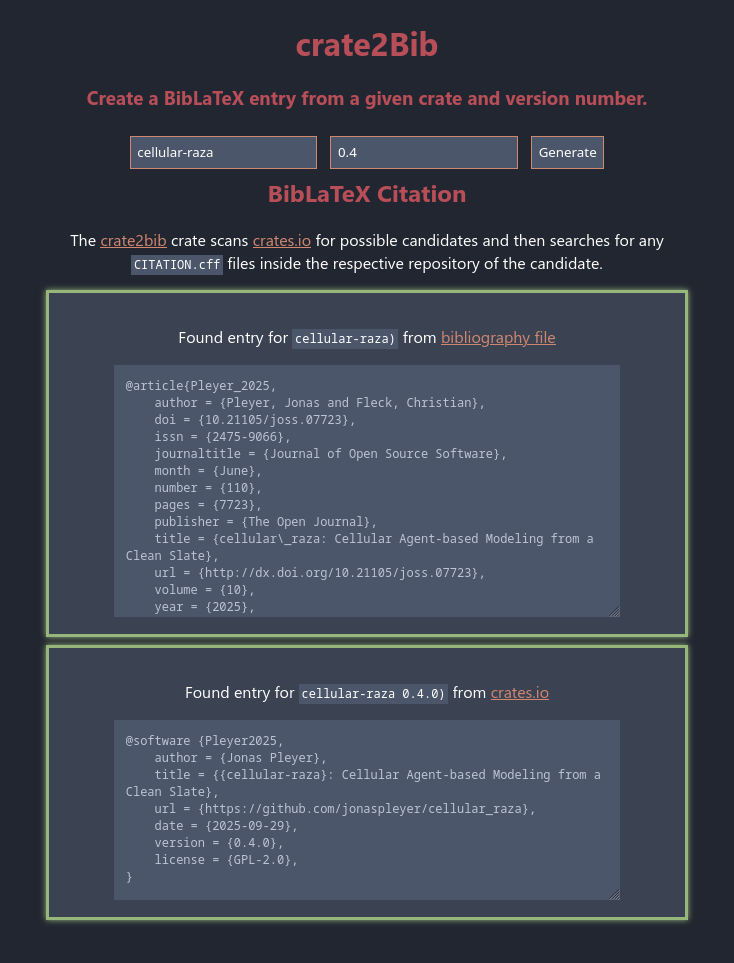
The webapp provides a simple interface to generate entries for particular crates with optionally provided version numbers. If multiple candidates for bibliography entries are available, they are all displayed.
The python bindings consist of only a single function get_biblatex which obtains the entry of the
specified crate.
Note that we have to provide a name for a user agent which is mandatory to access the API behind
crates.io.
import asyncio
from crate2bib import get_biblatex

async def obtain_result():
    results = await get_biblatex(
        "serde", "1.0.228", "crate2bib-py-testing-serde-user-agent"
    )
    biblatex = results[0]
    print(biblatex)
> @software {Tolnay2025,
> author = {David Tolnay},
> title = {{serde}: A generic serialization/deserialization framework},
> url = {https://github.com/serde-rs/serde},
> date = {2025-09-27},
> version = {1.0.228},
> license = {MIT OR Apache-2.0},
> }
Similarly to the python bindings, the CLI tool offers almost identical functionality.
Creates a BibTeX entry given a crate name and version number. Note: This crate respects semver.

Usage: crate2bib [OPTIONS] <CRATE_NAME>

Arguments:
  <CRATE_NAME>  The exact name of the crate. Note that underscores are synonymous to dashes in the API of crates.io

Options:
  -v, --ver <VER>                  A semver compliant version number (eg. "1", 0.1", "0.3.38") [default: ]
  -u, --user-agent <USER_AGENT>    The name of the user-agent. Automation tools
                                   should specify this variable to specify which
                                   user generates the requests. [default: crate2bib-cli-user-agent]
      --filenames <FILENAMES>      [default: CITATION.cff citation.bib]
  -b, --branch-name <BRANCH_NAME>  [default: ]
  -h, --help                       Print help
  -V, --version                    Print version
The rust crate behind the previously listed approaches is directly available at crates.io/crate2bib. It provides more functionality compared to the previous approaches and separates various sources for possible BibLaTeX entries such as Github and crates.io.
@software{Pleyer2025crate2bib,
      title={crate2bib: Citing Rust crates made easy},
      author={Jonas Pleyer},
      year={2025},
      eprint={2511.07468},
      archivePrefix={arXiv},
      primaryClass={cs.DL},
      url={https://arxiv.org/abs/2511.07468},
}