
An AI-native library and runtime for building reviewable business applications in TypeScript.
TeaQL gives coding agents business-shaped APIs, model-aware guidance and software checks. People review the business operation instead of reconstructing pages of query-building, relationship-loading and persistence code.
Automatic execution logs make those operations easier to debug and operate, without adding logging statements to every business method.
Try with your coding agent · Run the local example · See automatic logs
AI-native does not mean the library was written by AI, or that every query calls an LLM. It means the APIs, knowledge delivery and verification workflow are designed for how coding agents work: limited context, incomplete knowledge of a project and a tendency to guess unfamiliar operations.
The semantic model describes your business objects, fields, relationships and states. A generated domain library turns those words into language-native Q queries, E expressions and mutation methods. This repository provides the reusable, domain-independent runtime that executes them through metadata, Context, Checker, Policy and database providers.
The application workspace keeps business code and concise project guidance together. Progressive Assist supplies the exact API guidance needed for the next operation, instead of asking the agent to explore the entire generated library. Compilation, runtime checks and tests provide feedback beyond a prompt.
The benefit is visible in the application code: the query, data access path and audited change stay together, while shared mechanics live in the library and runtime.
| Application code to review | Shared work handled by TeaQL |
|---|---|
| A composed Q request | SQL construction and selected relation loading |
| An E access path | Loaded-field checks and explicit NULL handling |
| A mutation with an audit reason | Change tracking, Checker and configured Policy execution |
| Business intent and audit reason | Automatic execution logs and trace context without per-operation logging code |
Reviewers still decide whether the requested data, business rules and authorization policy are correct. They have less application plumbing to trace before making that decision; reuse does not make business logic correct automatically.
Token savings have not yet been measured in a controlled comparison. We make no numerical token-saving claim. Loading guidance only when needed is a context-management strategy; the smaller application review surface is visible in the examples, not a measured percentage reduction in review time.
The Robot Task Board showcase makes the idea concrete: move a task and follow the state change, generated SQL, field-level audit and refreshed board.
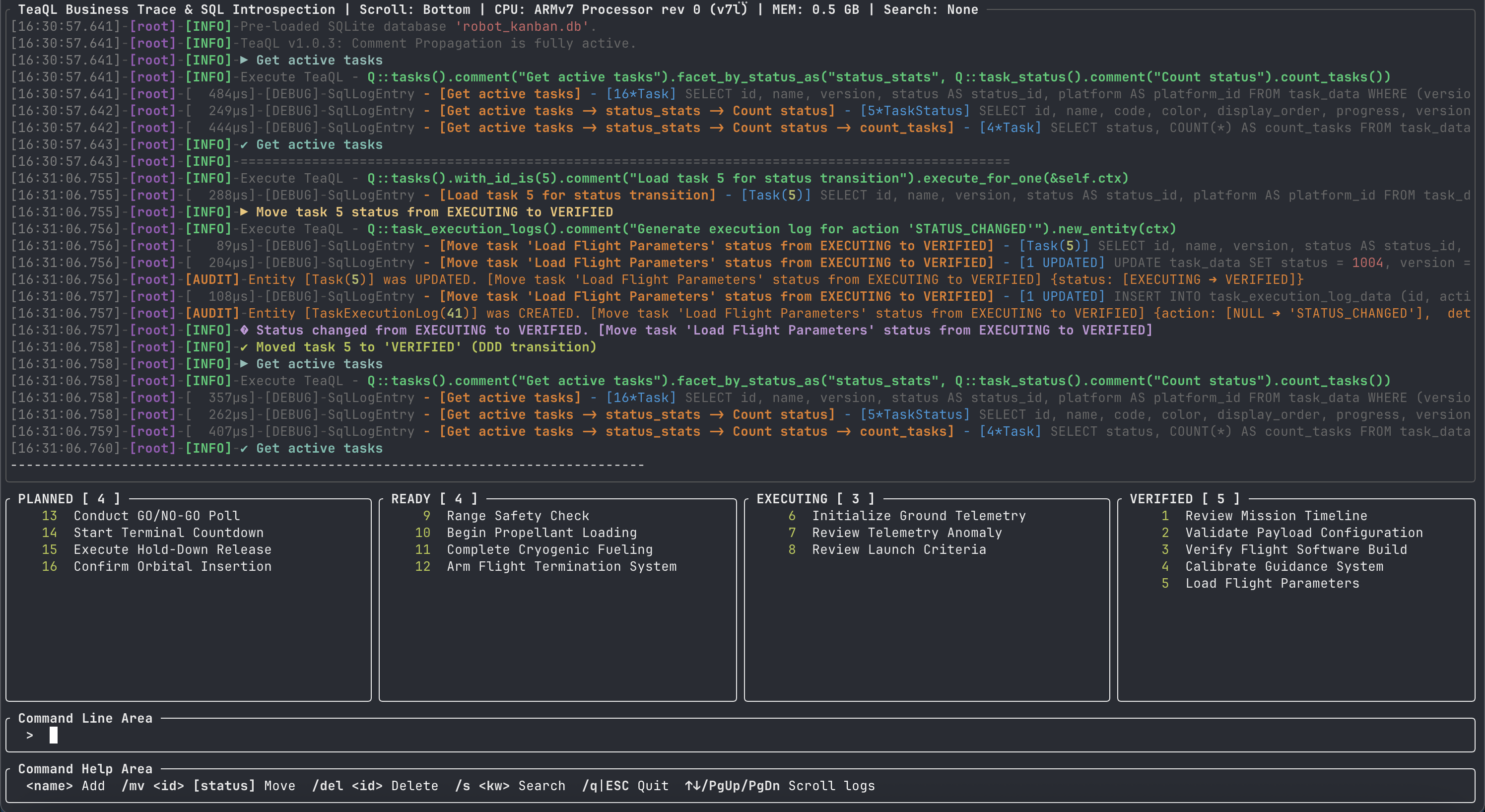
Explore the open-source demo. The showcase is a Rust application; the examples below use this repository's own TypeScript APIs.
These application-code excerpts assume the example's generated imports, trusted
Context and an existing object identity. Q and E belong to the generated
domain library, not a generic runtime object with arbitrary field strings.
See the application source for complete setup.
const schoolTypeDetails = Q.schoolTypesWithMinimalFields().selectName().selectCode();

const school = await Q.schools()
  .withIdIs(schoolId)
  .selectPlatformWith(Q.platformsWithMinimalFields().selectName().selectBaseUrl())
  .selectSchoolTypeWith(schoolTypeDetails)
  .comment("what: load the school and its reference data")
  .purpose("why: review a school before editing")
  .executeForOne(context);
if (!school) throw new Error("School not found");
The child request is a query in its own right. Give it a business name,
extract it into a helper and compose it into other requests like a Lego brick.
The reviewer can see which relationships are loaded without following a
separate set of SQL loops. comment describes what; purpose describes
why. Both must be non-empty, even when logging is disabled.
const schoolTypeId = E.school(school).schoolTypeId().eval();E reads the loaded graph without implicitly querying the database. A loaded NULL and a field that was NotLoaded are different facts. A business rule must not conclude that a value is absent merely because the query never requested it.
The access path is explicit, so the reviewer checks whether Q loaded the required data and whether the code handles a real NULL appropriately. Unloaded access produces the language-specific diagnostic; a NULL fallback is not permission to ignore an unloaded property.
The application declares the change and its reason instead of writing its own persistence loop. A graph can stage additions, updates and deletions before Save.
Load the complete scalar fields of every persisted object you actually modify. A display-only partial projection is not a complete mutation input. Unmodified reference objects do not have to become fully loaded just to save their parent.
school.updateName("Riverside Academy");
await school.auditAs("Rename the reviewed school").save(context);
Save traverses the reached mutation graph, runs Checker/Fix and the configured customer Mutation Policy, then uses the provider transaction boundary. An explicit policy denial blocks persistence. Missing customer policy or exact approval emits a warning; it is not automatic rejection. Marking for deletion stages a change—the audited Save performs it. Atomicity is provider/route scoped, not a distributed transaction across unrelated databases.
Debuggability and operability are core design goals. The Q and Save examples above contain no logging calls: you declare the business intent, and the runtime produces the execution diagnostics and trace context. Configured audit sinks receive change events without each application method having to construct its own field-level diff.
The intent declarations already belong to the business operation:
commentdescribes what the query does.purposeexplains why it runs.auditAsgives the reason for a saved change.
No-code logging means no handwritten logger calls in each business method, not an application without code or intent declarations. Runtime startup still configures any required sink; custom formats and destinations use the logging extension points rather than edits to every business operation.
- Debugging: connect a query's intent to generated SQL, execution outcome and the trace path when a screen or business operation behaves unexpectedly.
- Operations: follow query and mutation activity and use audit reasons and safely exposed changes to investigate incidents.
- Review: inspect the business operation without separately checking that every TeaQL execution path has a matching application logging statement.
Query and Mutation diagnostic logs are enabled by default and can be switched off independently. Logging off does not disable intent validation or Policy.
Illustrative, shortened view of the rename operation, not a literal logger format or a captured test result; the SQL excerpt omits additional selected fields:
query entity=School comment="load the reviewed object" purpose="edit form" outcome=success
SQL: SELECT id, version, name FROM school_data WHERE id = 42;
trace: School -> request -> sqlite -> select
mutation entity=School auditReason="Rename the reviewed school" outcome=committed
change: name "Riverside Primary School" -> "Riverside Academy"
lineage: School#42("Rename the reviewed school")
The declarations explain why; SQL and audit evidence show what happened. Together they help locate the relevant operation without reconstructing the entire call path from scattered application code.
SQL execution stays parameterized. Diagnostic SQL has parameters substituted
after field-aware masking; it is not a question-mark template you must manually
reconstruct. Ordinary bindings stay visible, sensitive bindings use the shared
mask algorithm, and credentials/unknown bindings stay hidden. A masked statement
is labeled MASKED; NOT REPLAYABLE; SQL that cannot be safely rendered is omitted.
Application mutation audits are delivered after commit and discarded on rollback.
This is not a durable audit outbox. Do not put secrets in comment or purpose.
A coding agent does not need every generated method in its context. Start with
the generated application's AGENTS.md and workspace guidance, request an
entity/action Assist, then ask for field-specific help only for the field
being used.
For a model in models/, the TypeScript query path is:
cargo teaql typescript-assist-query/school --input models/
cargo teaql typescript-assist-query/school.established_date --input models/
These commands call the model-aware service; the model must match the generated library. Assist uses canonical KSML entity and field names, even when the language-native API uses a different naming style. Cargo TeaQL is a service client for multiple languages, not just Rust.
Use Assist to discover operations instead of reading generated library source
or guessing names. If the required operation is missing, report
MISSING_ASSIST rather than inventing an API. The
Agent Kit defines this progressive
workflow. Library and runtime maintenance are separate from application coding.
AI proposes the model and application logic; software checks the parts that can be verified mechanically. The library is one part of the TeaQL harness, not a replacement for business review.
| Stage | TeaQL support | Feedback to inspect |
|---|---|---|
| Model and repair | Semantic model evaluation | Errors, warnings and repair guidance |
| Generate | Domain library combined with this runtime | Language tooling checks the generated API contract |
| Customize the workspace | Progressive Assist, Q, E and mutation APIs | Build diagnostics, Checker and configured Policy results |
| Verify and operate | Tests, runtime startup, intent and audit evidence | Actual outcomes, remaining failures and execution paths |
Build checks verify API use, not whether the business decision is right. Tests must still verify the application's behavior. A prompt, successful generation or a clean build alone does not prove the finished application correct.
You can start with an agent you already use. Paste this prompt:
Follow the current instructions at https://github.com/teaql/teaql-agent-kit.
Build a small school-management application in TypeScript using SQLite.
Evaluate and repair the model, generate the domain library and prepare a runnable
application workspace. Verify Q, E, Checker and audited Save.
Finish with a report of commands, results and
remaining frictions. Include Q/E examples and relevant intent/audit logs.
Do not claim token savings without a measured comparison.
The Agent Kit guides modeling, evaluation/repair, generation and application customization. It may install toolchains and download dependencies; review installation permissions and the final execution report. It is a workflow, not a guarantee of unattended correctness.
Node.js/npm for the repository examples. Browser SQLite runs in a Web Worker with SQLite/WASM. From a checkout of this repository:
cd examples/school-management
npm install
npx ts-node app.ts
The School example exercises SQLite schema/bootstrap and generated application APIs against this repository's local runtime. No external database server or generator is needed to run the retained generated example. Use only the example's test database; reset/repeated-run behavior is documented in its README.
Current documented runtime: 0.3.0. Keep domain-library and runtime versions compatible; regenerate older libraries when their provider or graph adapter SPI has changed.
npm install @teaql/teaql@0.3.0Use scoped imports such as @teaql/teaql or
@teaql/teaql/sql/sqlite. The default entry point is driver-free; choose only
the required profile and install its optional driver. Browser SQLite defaults
to memory; OPFS is an explicit persistence choice.
Generation is a separate service; see the Agent Kit for producing the application-specific library and workspace. Repository examples use local source; isolated released-package regression is a separate gate.
TypeScript supports browser/TFP, Node SQL, Expo SQLite and browser SQLite/WASM profiles. The browser is not a trusted server authorization boundary or a backend key store. Peggy parses a controlled query AST; it does not execute arbitrary JavaScript with eval or new Function.
One semantic model can produce language-native applications across Java, Rust, TypeScript, Go, Swift, .NET and Python. That does not imply identical APIs, providers or complete cross-language feature parity. The semantic model defines business objects, fields, relationships and states; it is not the language model used by a coding agent. The conformance matrices distinguish implemented source, executed examples, artifact verification and release.
npm test -- --runInBand
bash scripts/verify-examples.sh
The full example gate is the acceptance entry point for local runtime changes. External-provider tests need their configured services; skips are not live-provider evidence. A committed-operation error after audit delivery failure must not be retried as if the business transaction rolled back.
Install application-owned policies, ID/business-ID services, logging sinks, transports and other supported SPIs through trusted runtime/Context setup. Request JSON is not allowed to replace those trusted capabilities.
- Runtime guide: modules, SPI and advanced verification
- Runtime profiles
- Browser SQLite example
- Facet example
- Trace Chain example
Default diagnostics do not authorize plaintext sensitive data. Controlled debugging requires the exact acknowledgement below and any sensitive sink required by the runtime:
export TEAQL_ALLOW_SENSITIVE_PLAINTEXT_LOGS=I_UNDERSTAND_SENSITIVE_DATA_MAY_BE_WRITTEN_TO_DISKDebug output is explicitly labeled. Credentials and unknown bindings remain protected; the flag does not erase old files or govern application/driver prints outside TeaQL. Restrict access and retention, then unset it and restart. See the runtime guide for log switches and extension details.